About Me

I am currently a postdoc at UCSD working with Karin Sandstrom.
I am an observational astrophysicist that studies galaxy evolution with a focus on dust/PAHs in star forming galaxies and Active Galactic Nuclei (AGN), utilizing JWST observations in both the local universe and at cosmic noon. I am a member of the Galactic Activity Torus and Outflow Survey (GATOS) collaboration working on dust around local AGN while my work at cosmic noon is part of the PAHSPECS collaboration. My CV/resume is available here.
Research Positions
Postdoctoral Fellow, University of California San Diego, CA, USA (2025 - Present)
Postdoc University of Oxford (2025-2025)
Education
DPhil. Astrophysics, University of Oxford (Supervisors: Dimitra Rigopoulou, Ismael García-Bernete) (2021-2025)
MPhys. (1st class) Astrophysics, University of St. Andrews (Supervisors: Keith Horne, Juan Hernandez-Santisteban) (2016-2021)
Publications
A full list of publications can be found here.
Research
Polycyclic Aromatic Hydrocarbons (PAHs) across cosmic time.
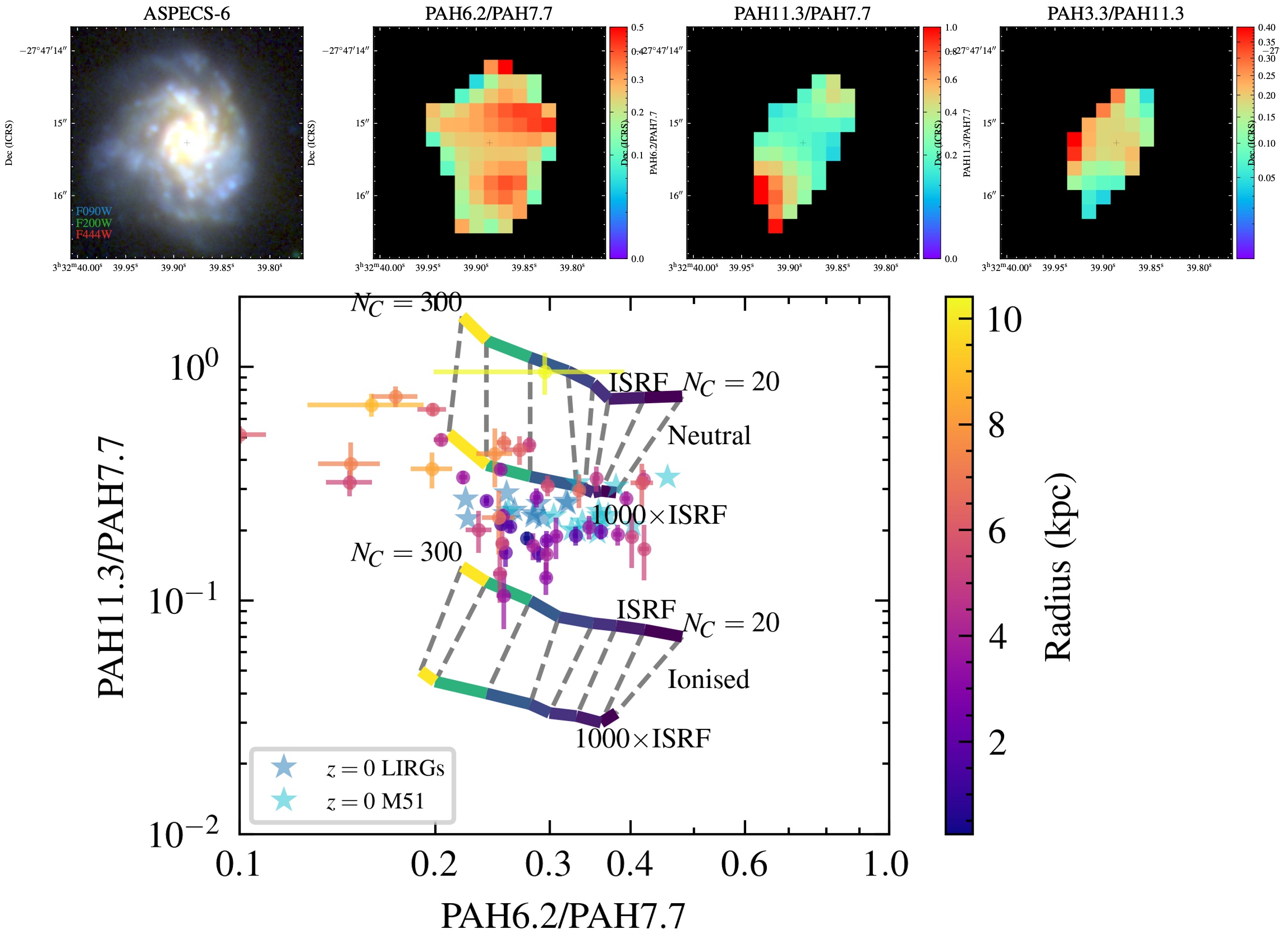
PAHs are molecules comprised of rings of carbon atoms and are ubiquitous in the interstellar medium (ISM) of galaxies. They are excited by UV photons from young stars which re-emit as broad emission features in the mid-infrared and thus are great diagnositcs of dust properties. In the local universe, using my spectral decomposition code, we have found PAHs to be altered by AGN, particularly in outflow regions (García-Bernete+24c, Rigopoulou+24) where PAHs appear more neutral. At cosmic noon, I am using MIRI spectroscopy from the PAHSPECS program to produce spatially resolved maps of PAH ratios at cosmic noon for the first time. The below figure shows an example where PAHs appear to become more neutral/larger with radius, the opposite of local galaxies.
The Obscured Growth of SMBHs
I use JWST near/mid-infrared spectroscopy to study the most obscured galactic nuclei at the hearts of Ultra Luminous Infrared Galaxies (ULIRGs). I have demonstrated how mid-infrared spectroscopy can be used to identify such objects where even X-rays fail ( Donnan+23a) which can be used to identify a potentially missing source of obscured SMBH growth across cosmic time both with JWST ( García-Bernete+25) and future telescopes such as PRIMA (Donnan+25). With the complex spectra JWST is producing of obscured envionments, I have produce the only fitting tool capable of fitting the most obscured galaxy nuclei (Donnan+24a), which employs a "differential extinction" model to produce a 2D distribution of dust extinction and temperature. The below figure demonstrates a fit with this tool with the inferred 2D dust distribution in the right panel. The code is publically available here.

Kinematics of PAHs
Unlike the gas phase of the ISM, dust largely emits thermally close to a blackbody, preventing any kinematics from being measured. However the PAH features, while broad, can be used to infer the kinematics of dust. In (Donnan+24b) I presented the first kinematic maps of PAHs using the technique of PCA tomography. The below figure shows this technique in action, opening a new window into the ISM of galaxies. This is particularly exciting to investigate a key open question about the dust around AGN, do AGN lauch dusty outflows/winds? In Donnan+26 (in prep.) I tackle this question using the GATOS sample.

Echo Mapping of AGN Accretion Disks
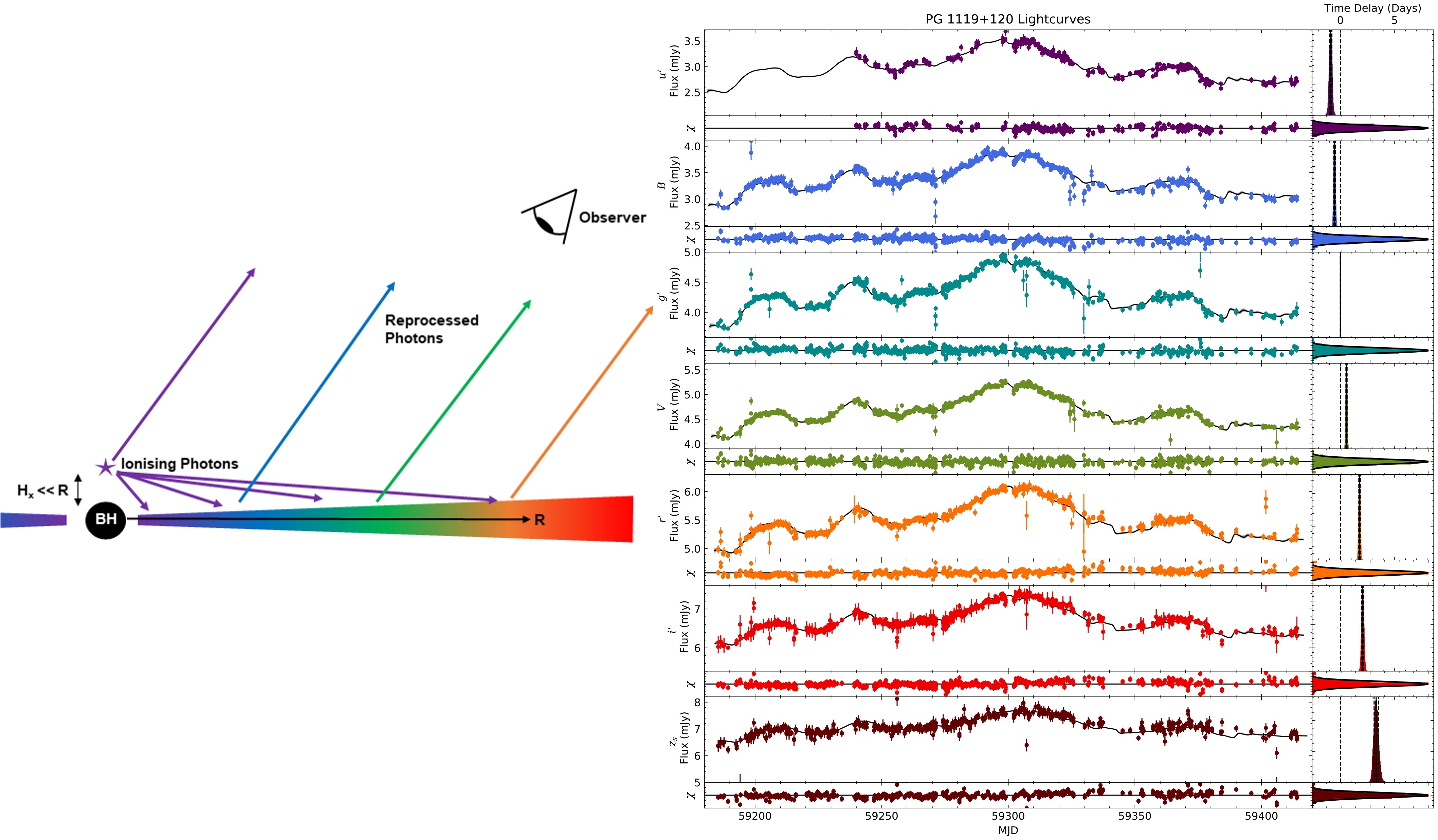
During my Masters work I developed a new tool (PyROA) to measure the time delays between AGN lightcurves, probing scales of light days in the accretion disk of the AGN, using a running optimal average (Donnan+21). This method is fully Bayesian and accounts for outliers and gaps in the lightcurves enabling accurate inference of the time delays between AGN lightcurves and is in use in numerous works. For example, in Donnan+23c, we used photometric time series observations of the local quasar PG1119+120, to test accretion in the super-Eddington regime. The tool is publically available here.
Software
SPIRIT - SPectral InfraRed Inference Tool
I have built a spectral decomposition tool for near/mid-infrared JWST spectra which is able to fit a variety of kinds of spectra, from simple star-forming regions to AGN and highly obscured regions. This allows one to extract accurate PAH fluxes as well as infer the nature of the obscuring dust via the inferred 2D dust distribution of extinction and temperature. Below is an example fitting to a variety of different spectra from the GOALS ERS program as well as the GUI to easily fit spectra. The code is publically available here.
The code is easy to run with an interactive GUI where various different options can be selected such as the extinction curve, ice templates and the fitting method.


PyROA - Modelling AGN Lightcurves
PyROA is a tool for modelling quasar lightcurves (Donnan et al. 2021) where the variability is described using a running optimal average (ROA), and paramters are sampled using Markov Chain Monte Carlo (MCMC) techniques - specifically using emcee. Using a Bayesian approach, priors can be used on the sampled parameters. It can also intercalibrate same-filter ligthcurves from different telescopes and adjust their uncertainties accordingly ( Donnan et al. 2023). Currently it has three main uses:
- Determining the time delay between lightcurves at different wavelengths.
- Intercalibrating lightcurves from multiple telescopes, merging them into a single lightcurve.
- Determining the time delay between images of lensed quasars, where the microlensing effects are also modelled.
PyROA also includes a noise model, where there is a parameter for each lightcurve that adds extra variance to the flux measurments, to account for underestimated errors. This can be turned off if required.
The code is easy to use with example jupyter notebooks provided, demonstrating each of the three main uses. The code is ran by specifying a directory which contains each of the lightcurves as a .dat file with the columns being time, flux, flux_err in that order. All that is also needed is to specify the prior, specifically the limits of a uniform prior on each of the parameters. The Code is available here.

Contact
Elements
Text
This is bold and this is strong. This is italic and this is emphasized.
This is superscript text and this is subscript text.
This is underlined and this is code: for (;;) { ... }. Finally, this is a link.
Heading Level 2
Heading Level 3
Heading Level 4
Heading Level 5
Heading Level 6
Blockquote
Fringilla nisl. Donec accumsan interdum nisi, quis tincidunt felis sagittis eget tempus euismod. Vestibulum ante ipsum primis in faucibus vestibulum. Blandit adipiscing eu felis iaculis volutpat ac adipiscing accumsan faucibus. Vestibulum ante ipsum primis in faucibus lorem ipsum dolor sit amet nullam adipiscing eu felis.
Preformatted
i = 0;

while (!deck.isInOrder()) {
    print 'Iteration ' + i;
    deck.shuffle();
    i++;
}

print 'It took ' + i + ' iterations to sort the deck.';
Lists
Unordered
- Dolor pulvinar etiam.
- Sagittis adipiscing.
- Felis enim feugiat.
Alternate
- Dolor pulvinar etiam.
- Sagittis adipiscing.
- Felis enim feugiat.
Ordered
- Dolor pulvinar etiam.
- Etiam vel felis viverra.
- Felis enim feugiat.
- Dolor pulvinar etiam.
- Etiam vel felis lorem.
- Felis enim et feugiat.
Icons
Actions
Table
Default
| Name |
Description |
Price |
| Item One |
Ante turpis integer aliquet porttitor. |
29.99 |
| Item Two |
Vis ac commodo adipiscing arcu aliquet. |
19.99 |
| Item Three |
Morbi faucibus arcu accumsan lorem. |
29.99 |
| Item Four |
Vitae integer tempus condimentum. |
19.99 |
| Item Five |
Ante turpis integer aliquet porttitor. |
29.99 |
|
100.00 |
Alternate
| Name |
Description |
Price |
| Item One |
Ante turpis integer aliquet porttitor. |
29.99 |
| Item Two |
Vis ac commodo adipiscing arcu aliquet. |
19.99 |
| Item Three |
Morbi faucibus arcu accumsan lorem. |
29.99 |
| Item Four |
Vitae integer tempus condimentum. |
19.99 |
| Item Five |
Ante turpis integer aliquet porttitor. |
29.99 |
|
100.00 |